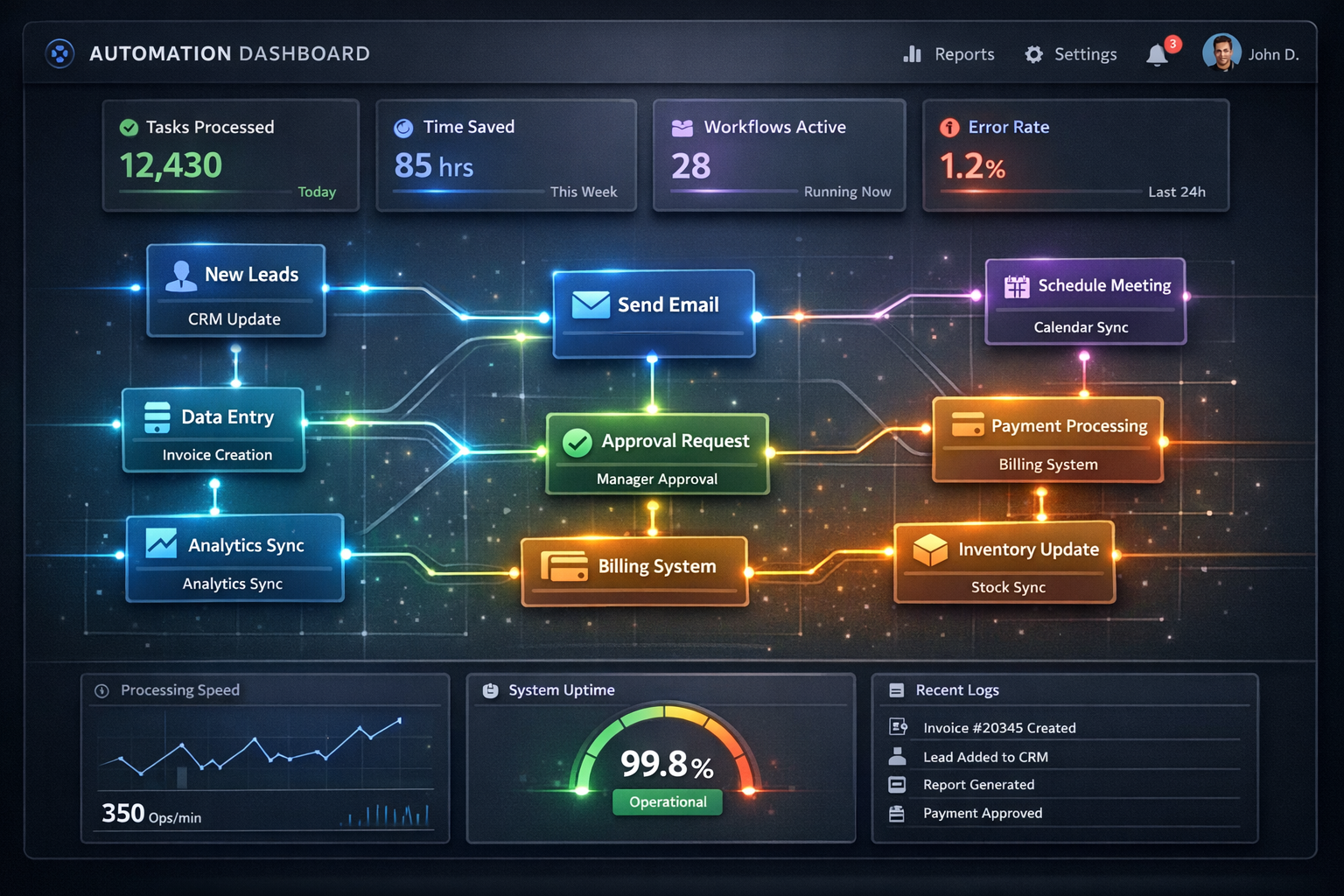
Local service businesses—think HVAC, plumbing, landscaping, home cleaning, dental and legal practices—live and die by responsiveness and follow-through. In 2026, AI automation is making it easier to respond faster, reduce manual work, and convert more inquiries into booked jobs—without adding headcount.
This guide explains what’s changing in 2026, where ai automation for small business is delivering real value, and how to choose business automation tools that fit your operations.
Why 2026 is a turning point for local service automation
Customers increasingly expect immediate answers: a quick text, a clear estimate, and a simple way to book. At the same time, local providers are managing multiple channels—calls, forms, emails, reviews, ads, and sometimes messaging apps.
In 2026, AI automation is helping businesses connect these moving parts. Instead of “more tasks,” many teams can automate the process: capture the lead, qualify it, route it, respond, and schedule—while humans focus on the work that requires a person.
What AI automation can automate for local service businesses
AI automation isn’t one single feature. It’s a set of capabilities that support key customer and internal workflows.
1) Lead capture and instant response
When someone fills out your website form or calls, speed matters. AI-enabled automation can help you respond quickly by:
- Auto-notifying the right team member or dispatch group
- Sending a timely confirmation message to the customer
- Gathering key details (service type, location, preferred times) before a human takes over
2) Lead qualification (so you don’t waste time)
Not every inquiry is ready to schedule today. AI automation can assist by asking structured questions, flagging likely-fit leads, and routing requests based on criteria such as:
- Service category and urgency
- Coverage area or zip code
- Whether the customer is requesting estimates or availability only
3) Scheduling, rescheduling, and follow-ups
Scheduling is often where leads slip through. AI automation tools can streamline booking by:
- Updating availability and confirming appointments
- Sending reminders and reducing no-shows
- Handling common reschedule requests
4) Customer communication at scale
Local businesses often repeat the same information: pricing ranges, service areas, what to expect, and how to prepare. AI automation for small business can reduce repetitive effort with:
- FAQs and service-specific responses
- Consistent messaging across channels
- Optional escalation to a human for complex questions
5) Review and reputation support
Positive reviews directly impact local visibility. Automation can help by triggering review requests after a completed job and routing unhappy customers to a resolution workflow rather than letting issues sit.
6) Internal operations: job notes, quotes, and handoffs
Some AI automation tools can help reduce manual admin work by summarizing customer messages, organizing job details, and standardizing quote requests. This improves consistency and helps teams move faster from inquiry to job.
Benefits local owners can expect (without overpromising)
AI automation typically delivers value in a few practical areas. Results vary based on your processes, volume of leads, and how you implement tools.
- More leads converted: Faster response times and consistent follow-ups can help you capture “hot” prospects.
- Lower operating costs: Less manual data entry, fewer missed messages, and smoother handoffs reduce wasted time.
- Better customer experience: Clear, timely communication builds trust.
- Scalability: You can handle higher inquiry volumes with the same team by automating repetitive steps.
How to choose business automation tools in 2026
Not all automation tools are equal. The best choice depends on your workflow and the systems you already use.
Start with your bottlenecks
Before buying anything, map where leads get stuck: form submissions that go unanswered, scheduling delays, slow follow-up, missed calls, or inconsistent quoting.
Look for integration with your current stack
To truly automate local business processes, your tools should connect with the systems you rely on—such as your CRM, scheduling platform, email, SMS, and call routing. Choose tools that support integrations and clear data flow.
Prioritize human control and escalation
AI should assist, not create risk. Select solutions that allow:
- Escalation to a team member
- Role-based access and approvals
- Logging/auditing of key actions
Check quality and compliance basics
For customer-facing automation, review how messages are generated, stored, and updated. Ensure your business stays compliant with relevant privacy, consent, and communication rules in your region.
A simple roadmap to automate local business in phases
If you want results without disrupting operations, implement automation in stages.
Phase 1: Automate lead response and routing
Goal: reduce time-to-first-response and ensure every inquiry is handled.
Phase 2: Automate scheduling and follow-ups
Goal: make booking frictionless and improve show-up rates with reminders.
Phase 3: Add qualification and customer communication workflows
Goal: ask the right questions, provide consistent answers, and route complex cases to humans.
Phase 4: Optimize with feedback and reporting
Goal: improve automation accuracy and refine messaging based on real outcomes—like booked jobs, response times, and customer feedback.
Common mistakes local businesses make with AI automation
- Automating a bad process: If leads aren’t qualified or your quoting flow is unclear, automation will amplify the issue.
- Too much automation too soon: Start with a high-impact, low-risk workflow.
- Weak data and inconsistent lead capture: Clean forms, standardized fields, and proper routing matter.
- No review loop: Automation should be monitored and adjusted as your services and customer questions evolve.
How K10 Global helps local service businesses implement AI automation
At K10 Global, the focus is practical: helping local businesses apply AI automation to real workflows—so you can automate local business tasks like lead capture, routing, follow-ups, and scheduling while maintaining a professional customer experience.
If you’re exploring ai automation for small business, we can help you identify where automation will have the biggest impact and guide you toward the right business automation tools and implementation approach.
Strong CTA: Let’s automate your lead flow
Ready to convert more inquiries without adding more manual work? Contact K10 Global today to discuss your current lead and scheduling process and identify the fastest path to effective AI automation for your local service business.
Get started now—reach out to K10 Global and we’ll help you map out a clear automation plan for 2026.