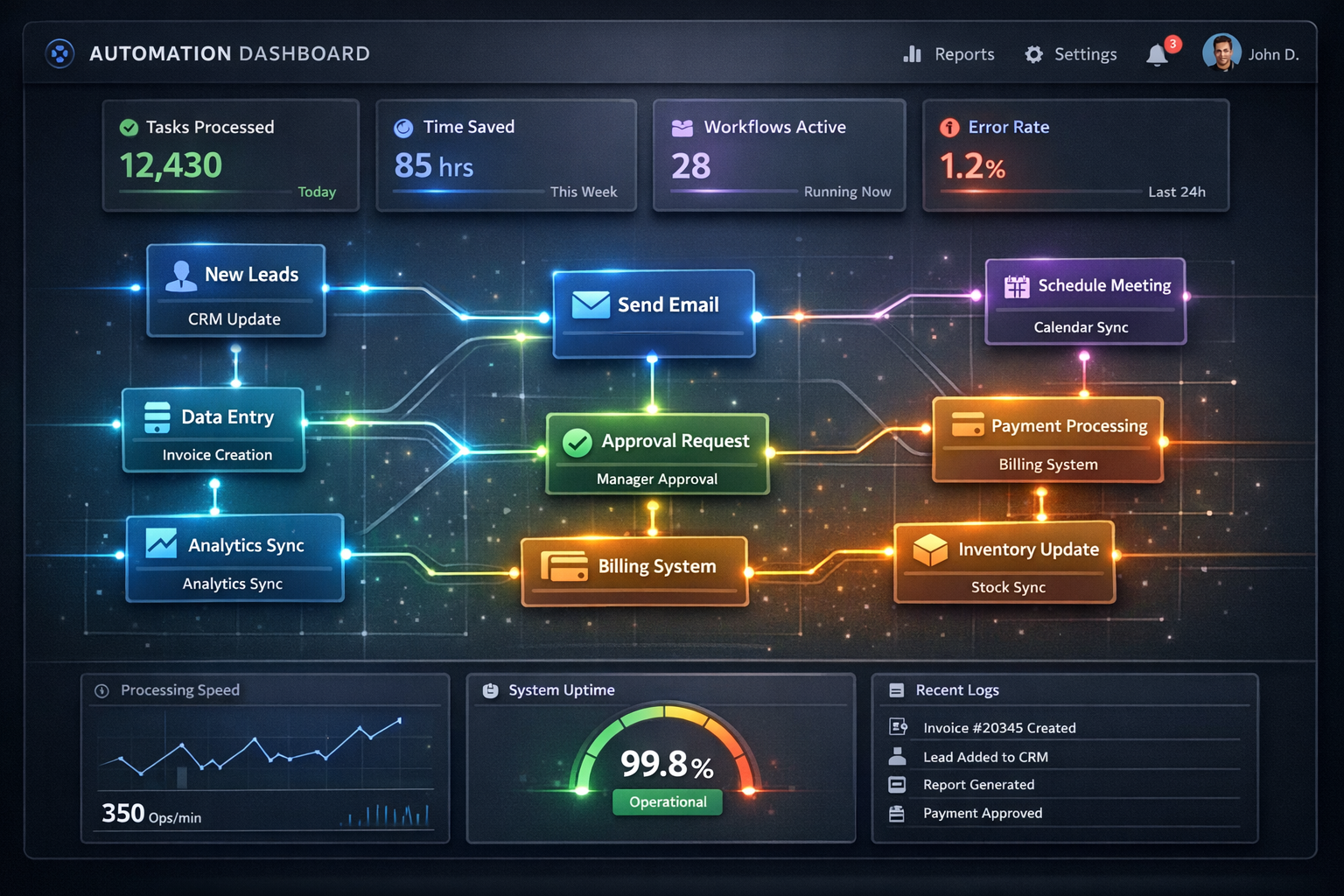
Scaling a business shouldn’t require constant overtime, more headcount for every new task, or “heroic” problem-solving each week. The businesses that grow steadily build a scalable business system—one that turns repeatable work into reliable processes, then uses automation systems business practices to reduce manual effort and improve consistency.
In this guide, you’ll learn how to design business growth automation that supports real outcomes: faster turnaround, fewer errors, better visibility, and fewer bottlenecks.
What is a scalable business system?
A scalable business system is a set of documented workflows and rules that reliably deliver outcomes—regardless of whether you have 5 customers or 500. Instead of depending on individual knowledge, the work is structured so your team can execute it the same way every time.
In practical terms, it includes:
- Defined processes (how work moves from request to delivery)
- Clear ownership (who does what, and when)
- Standard inputs and outputs (what information is required, what “done” looks like)
- Feedback loops (how quality is checked and improved)
- Automation where it helps (to remove repetitive steps and reduce handoffs)
Why automation is the accelerator (not the foundation)
Automation is powerful, but it’s not a substitute for process design. If your workflow is inconsistent, automating it can spread confusion faster. The strongest approach is:
- Map the workflow (understand what actually happens)
- Standardize the workflow (remove unnecessary variation)
- Automate specific steps (where rules and triggers are clear)
- Measure and improve (optimize based on results)
This is how you build automation systems business capabilities that support growth without increasing chaos.
Step-by-step: build a scalable business system with automation
1) Start with one outcome, not a tool list
Pick a business outcome that you want to improve (and that will scale):
- Lead response time
- Sales pipeline management
- Customer onboarding consistency
- Invoice delivery and payment follow-ups
- Support ticket routing and resolution
Define the outcome and success criteria before choosing tools.
2) Identify repeatable workflows
Walk through your operations and highlight tasks that happen frequently and follow a predictable pattern. Good candidates include:
- Capturing information (forms, emails, intake calls)
- Routing requests (to the right person/team)
- Scheduling (appointments, follow-ups)
- Updating records (CRM, spreadsheets, project boards)
- Notifications (internal alerts, customer confirmations)
- Document generation (templates, proposals, contracts)
Tip: If a step requires “tribal knowledge” to interpret, standardize it before automating it.
3) Document your workflow like you’re training a new hire
Create a simple workflow map. Include:
- Trigger (what starts the process)
- Inputs (what information is required)
- Decision points (what conditions change the path)
- Actions (what happens next)
- Outputs (what is produced)
- Owner (who is accountable)
This documentation becomes the blueprint for both your team and your business growth automation.
4) Build the “system layer”: rules, templates, and handoffs
Before integrating automation, create the infrastructure that makes the automation reliable:
- Templates (emails, messages, documents)
- Standard naming and tagging (so reporting stays clean)
- Decision rules (if/then logic for routing and approvals)
- Handoff standards (what information each role needs)
This is often where businesses unlock real scale—even before advanced automation is added.
5) Automate the steps that are rule-based
Look for tasks that follow clear triggers and rules. Common automation targets include:
- Form-to-CRM syncing and lead enrichment
- Email sequences based on behavior or status
- Automatic task creation for follow-ups and approvals
- Calendar scheduling with confirmed availability
- Customer onboarding checklists with timed reminders
- Invoice reminders and payment status updates
- Ticket routing by category, urgency, or product
As you automate, ensure each automated step has a clear “what happens if it fails” path (e.g., alerts, fallbacks, or manual review).
6) Use AI carefully to enhance, not replace
AI tools can be useful for accelerating work such as drafting responses, summarizing notes, or extracting structured data from unstructured inputs. The best practice is to use AI to:
- Reduce time spent on first drafts
- Standardize formatting and messaging
- Support routing and categorization
Always review AI outputs for accuracy and brand fit—especially for customer-facing communication.
7) Add visibility: reporting and process dashboards
If you can’t see what’s happening, you can’t scale it. Track key workflow metrics relevant to the outcome you chose. For example:
- Time from lead capture to first response
- Conversion rates by stage
- Onboarding completion rates
- Average time to resolve tickets
- Invoice aging trends
These measurements help you identify bottlenecks and improve the system over time—an essential part of sustainable automation systems business growth.
8) Create a maintenance routine
Automation systems aren’t “set and forget.” Build a lightweight maintenance cadence:
- Monthly workflow review (what’s working, what’s drifting)
- Quarterly template and rule optimization
- Occasional tool audits (cleanup integrations, permissions, duplicates)
This keeps your scalable business system aligned with how your business evolves.
Common mistakes that block scalable automation
- Automating a broken process instead of standardizing it first
- Overbuilding too early (adding complex integrations before validating value)
- Using too many tools without a process (fragmented workflows increase friction)
- No owner for outcomes (systems need accountability)
- Ignoring edge cases (every workflow needs failure handling)
How K10 Global helps businesses implement system-driven automation
At K10 Global, we help business owners design and implement automation that supports business growth automation—without sacrificing clarity, quality, or control. The goal is simple: build a scalable business system where your team knows what to do, your tools do the repetitive work, and your operations become easier to manage as you grow.
Strong CTA: Ready to scale without chaos?
If you’re ready to replace manual bottlenecks with a system that supports growth, contact K10 Global to map your best automation opportunities and turn them into dependable workflows. We’ll help you prioritize the highest-impact areas, design a scalable approach, and implement automation that fits your business.
Get started today: Schedule a consultation with K10 Global.