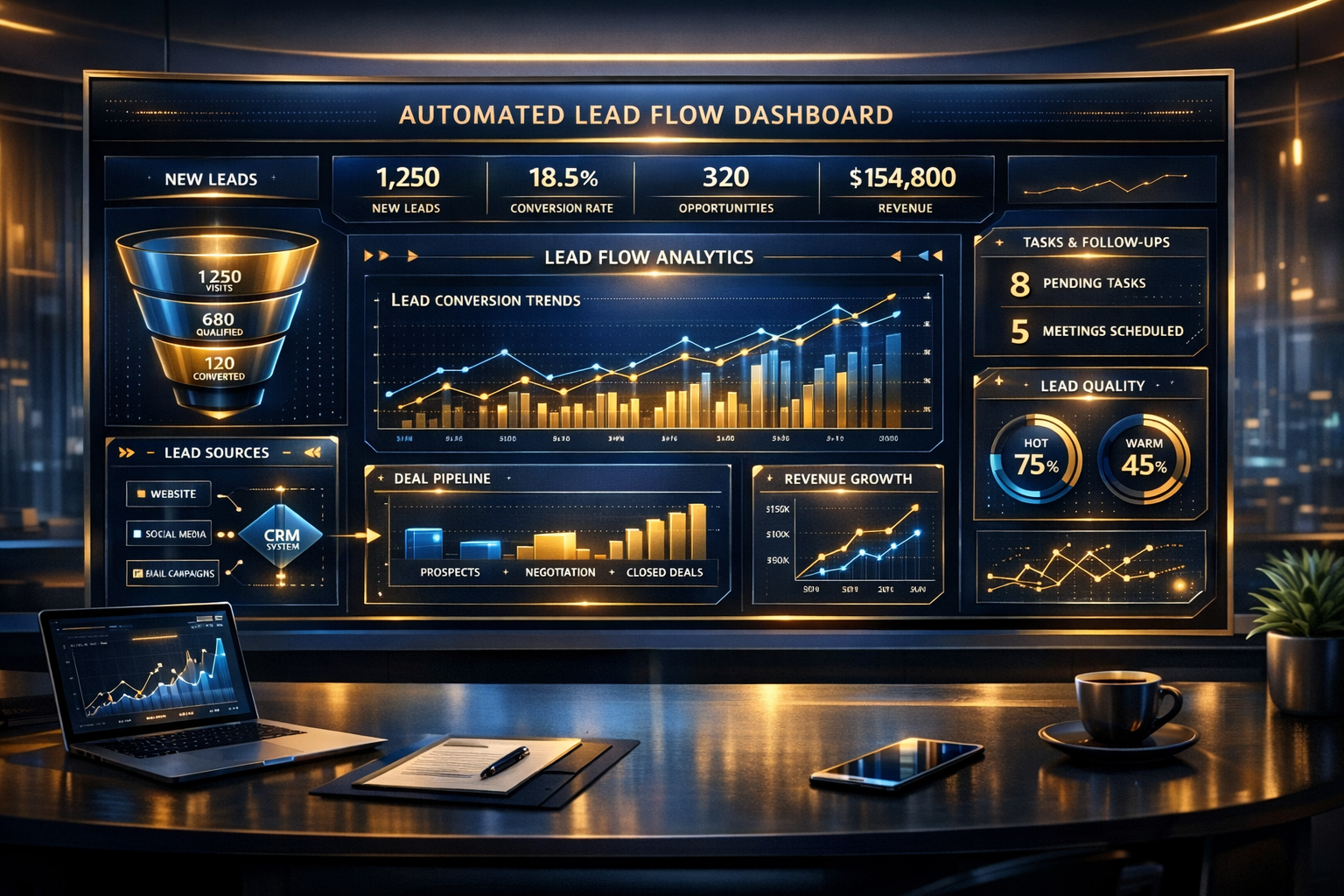
Generating leads consistently is one of the biggest challenges business owners face—especially when manual outreach doesn’t scale. The good news: you can use AI lead generation and automation marketing tools to improve targeting, respond faster, and nurture prospects more effectively.
In this guide, you’ll learn practical ways to generate leads online using tools and workflows you can implement step-by-step—without relying on hype or gimmicks.
Why AI and automation work for lead generation
Traditional lead generation often fails because it’s slow, inconsistent, and hard to personalize at scale. AI and automation help by:
- Improving data quality (cleaning lists, enriching profiles, standardizing fields)
- Matching intent to action (routing leads based on signals and behaviors)
- Reducing response time (instant follow-up to new inquiries)
- Personalizing at scale (tailoring messaging using stored context and segmentation)
- Maintaining consistent outreach (follow-ups and nurture sequences)
Step 1: Define your lead criteria (so AI can help)
AI performs best when you clearly define what “good leads” mean. Before building workflows, document:
- Ideal customer profile (ICP): industry, company size, roles, geography
- Buyer intent signals: website pages viewed, form submissions, event attendance, keyword research topics
- Qualification rules: budget/timeline, use case, decision-maker fit
This becomes the foundation for your AI lead generation approach and helps prevent wasted outreach.
Step 2: Capture leads with conversion-focused landing pages
To generate leads online, you need pages designed to convert. Focus on:
- Single purpose per landing page (one offer, one CTA)
- Clear value proposition aligned to your ICP
- Friction reduction: only ask for the information you truly need
- Fast follow-up triggered immediately after submission
Automation marketing tools can route new leads to the right person and start nurturing sequences automatically.
Step 3: Enrich and score leads automatically
Once you have leads, you need a system to decide who to contact first. Use automation to:
- Enrich profiles (company details, role mapping, industry tagging)
- Deduplicate records (avoid contacting the same person twice)
- Assign lead scores based on qualification rules and engagement
Tip: Start with simple scoring (e.g., ICP match + intent signal). As your data improves, you can refine scoring and routing logic.
Step 4: Automate the “speed-to-lead” process
Speed matters because many prospects decide quickly whether to engage. Create an automated flow that:
- Sends an immediate confirmation email or SMS
- Routes the lead to the correct owner by criteria (industry, region, deal size)
- Logs all interactions in your CRM
- Alerts sales when a lead reaches a “ready to talk” threshold
This is one of the most practical ways to increase conversions without increasing headcount.
Step 5: Use AI for personalization that still feels human
AI is especially useful for speeding up personalization—not replacing your voice. Consider using AI to:
- Draft outreach messages based on industry, role, and lead activity
- Create variations for different segments (e.g., “owner” vs. “manager”)
- Turn a prospect’s webpage or form responses into a tailored first-line message
- Summarize lead context for sales calls
Best practice: Use templates plus AI suggestions, and always review for accuracy and tone. Your goal is relevance, not automation that sounds generic.
Step 6: Build nurture sequences that don’t annoy people
Most leads aren’t ready to buy immediately. Nurture sequences help by delivering useful content until they are. A strong sequence typically includes:
- Timely follow-up after the initial interaction
- Value-based content (guides, case studies, checklists)
- Segmented messaging based on their interest
- Clear CTAs (book a call, request a demo, download a resource)
Automation marketing tools can manage timing, stop outreach when a prospect converts, and suppress messages when someone unsubscribes—helping keep your program compliant and respectful.
Step 7: Improve your lead sources with AI-assisted research
To generate consistent leads, you need a repeatable acquisition engine. AI can help you research and prioritize targets by:
- Identifying companies that match your ICP patterns
- Suggesting relevant content topics based on what your buyers search for
- Finding common pain points and differentiators to highlight
Use this research to create outreach lists and content that aligns with real buyer needs—not guesswork.
Step 8: Track what matters and refine your system
Automation is only as good as the feedback loop behind it. Track metrics such as:
- Conversion rate from landing pages and forms
- Speed to lead (time from submission to first response)
- Reply/meeting rate for outreach sequences
- Lead-to-opportunity rate and pipeline contribution
- Unsubscribe or suppression rates to ensure you’re not over-messaging
Then iterate: adjust lead scoring, tighten your segments, improve messaging, and refine your offer. This is where your lead generation becomes durable.
Common mistakes to avoid
- Using AI without clean data: poor lists lead to poor results.
- Automating outreach before qualification: you’ll waste time on low-fit leads.
- Letting messaging get generic: personalization should reference real context.
- Not closing the loop: if you don’t measure outcomes, you can’t optimize.
- Overbuilding too early: start with a simple workflow that you can improve.
How K10 Global can help
AI and automation work best when they’re implemented with your business goals, data, and sales process in mind. At K10 Global, we help businesses set up practical lead generation systems—connecting the right tools, workflows, and messaging so you can generate leads online more reliably and convert them more effectively.
Call to action
Ready to generate more qualified leads with AI and automation? Contact K10 Global to discuss your current funnel and identify the fastest opportunities to improve lead capture, routing, and nurturing. We’ll help you build a workflow you can trust—built for results, not noise.