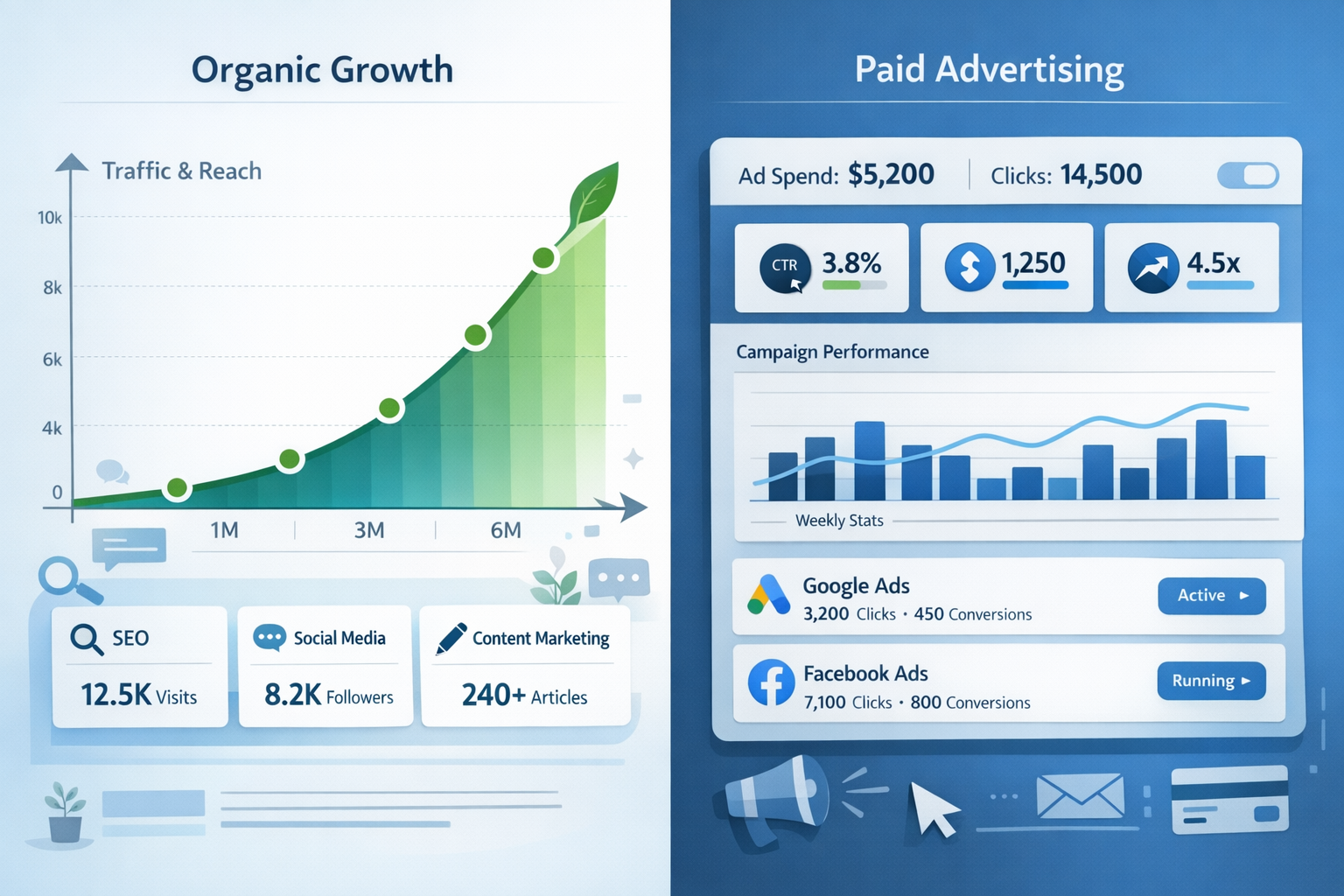
Deciding between SEO and paid ads can feel like choosing between long-term growth and fast results. Both are valuable parts of a digital marketing strategy—yet they work differently, cost differently, and suit different business goals. In this guide, we’ll compare seo vs google ads and help you choose the right mix for organic vs paid traffic.
Quick definition: SEO and paid ads
SEO (Search Engine Optimization)
SEO is the process of improving your website so it can rank in organic search results. It typically involves keyword research, content creation, technical improvements, and ongoing optimization.
Paid ads (Google Ads and other platforms)
Paid ads place your business at the top (or within) search results through budgeted campaigns. You pay when users click (or based on other ad pricing models), and visibility can be turned on or off depending on spend.
SEO vs Google Ads: how they differ
| Factor | SEO | Paid Ads |
|---|---|---|
| Time to results | Usually slower; results build over time | Faster; visibility can start quickly |
| Cost model | Invest in content + optimization (ongoing work) | Ongoing ad spend while campaigns run |
| Traffic quality | Often strong when rankings match search intent | High-intent traffic possible, but depends on targeting and offers |
| Dependence on spend | Less dependent on continuous payments | Stops or reduces when budget is paused |
| Stability | Can be more stable long-term with consistent effort | More variable due to competition and budget |
Pros and cons of SEO (organic vs paid traffic)
Pros of SEO
- Compounding returns: Well-optimized pages can continue to attract visitors over time.
- Credibility and trust: Ranking organically can increase perceived legitimacy.
- Lower ongoing cost per click: Once rankings are earned, traffic isn’t directly tied to ad bids.
- Better alignment with intent: SEO can target specific queries your customers are actively searching for.
Cons of SEO
- Time to impact: Meaningful results often take weeks to months (especially for competitive terms).
- Requires consistency: SEO is an ongoing improvement process, not a one-time setup.
- Algorithm and competition changes: Rankings can shift, requiring periodic updates.
Pros and cons of paid ads
Pros of paid ads
- Speed: You can launch and test messaging quickly.
- Control: Budget, targeting, locations, and ad copy can be adjusted to match goals.
- Useful for competitive keywords: If you need visibility now, ads can help bypass ranking delays.
- Good for testing: Ads can validate offers, landing pages, and keywords before you scale SEO.
Cons of paid ads
- Ongoing costs: Performance depends on continued spend.
- Volatility: Costs and results can change as competition and platforms evolve.
- Landing page dependency: Clicks don’t equal conversions—your on-page experience must match the promise.
- Traffic stops when you stop spending: Unlike organic visibility, ads don’t persist automatically.
Which is better: seo vs google ads?
The best answer for most businesses is: neither is universally better. The right choice depends on your timeline, budget, conversion readiness, and market competitiveness.
Choose SEO first if…
- You want sustainable growth and can invest in ongoing optimization.
- Your sales cycle is not purely dependent on immediate traffic.
- You have (or can build) strong content and landing pages that match user intent.
- You’re aiming to reduce long-term reliance on ad spend.
Choose paid ads first if…
- You need traffic and leads quickly to support growth.
- You’re launching a new product, service, or location and need visibility now.
- You have a clear offer and conversion-ready landing pages.
- You want to test keywords and messaging before committing to a long SEO roadmap.
The best digital marketing strategy: combine organic and paid traffic
Many business owners achieve better results by building a combined digital marketing strategy. Here’s a practical way to approach it:
1) Use paid ads to validate demand and messaging
Run targeted campaigns for a defined period to learn which keywords, angles, and landing pages drive conversions. Use those learnings to shape your SEO priorities.
2) Use SEO to capture long-term search demand
Create and improve content that targets the same themes your ads test. Over time, this can reduce dependency on ad spend and improve margin.
3) Strengthen landing pages for both channels
Whether visitors arrive via organic search or Google Ads, your landing pages should clearly communicate:
- What you offer
- Who it’s for
- Why it’s different
- How to take the next step (CTA)
4) Track outcomes, not just traffic
Focus on conversions like leads, calls, purchases, demo requests, or qualified inquiries. Then decide where to allocate budget and effort.
Common mistakes business owners make
- Choosing one channel too narrowly: SEO and paid ads can work together to fill gaps and reinforce results.
- Sending ad traffic to weak pages: If landing pages aren’t aligned with search intent, both channels suffer.
- Ignoring technical SEO: Page speed, crawlability, indexing, and site structure can limit performance.
- Not measuring properly: Without conversion tracking and clear KPIs, it’s hard to improve.
How K10 Global can help
At K10 Global, we help businesses build a practical search growth plan—whether you’re leaning toward seo vs google ads, improving existing rankings, or scaling paid campaigns. Our approach focuses on strategy, conversion alignment, and measurable results so your traffic turns into real opportunities.
Strong CTA: Get a tailored SEO + Ads plan
Ready to decide the best path for your business? Contact K10 Global for a strategy consultation. We’ll review your goals, current performance, and market opportunities to recommend the right balance of organic vs paid traffic—and the next steps to drive growth.